From ‘Normal People’ to ‘Intermezzo’: Sally Rooney’s Anatomy of Love, Grief, and Moral Conscience
In an insightful literary review, acclaimed filmmaker and critic Sajeed Naduthody explores Sally Rooney's trajectory from the class tensions of ‘Normal People’ to the raw fraternal grief of ‘Intermezzo’—revealing why her narrative brilliance mirrors her fearless real-world moral integrity.
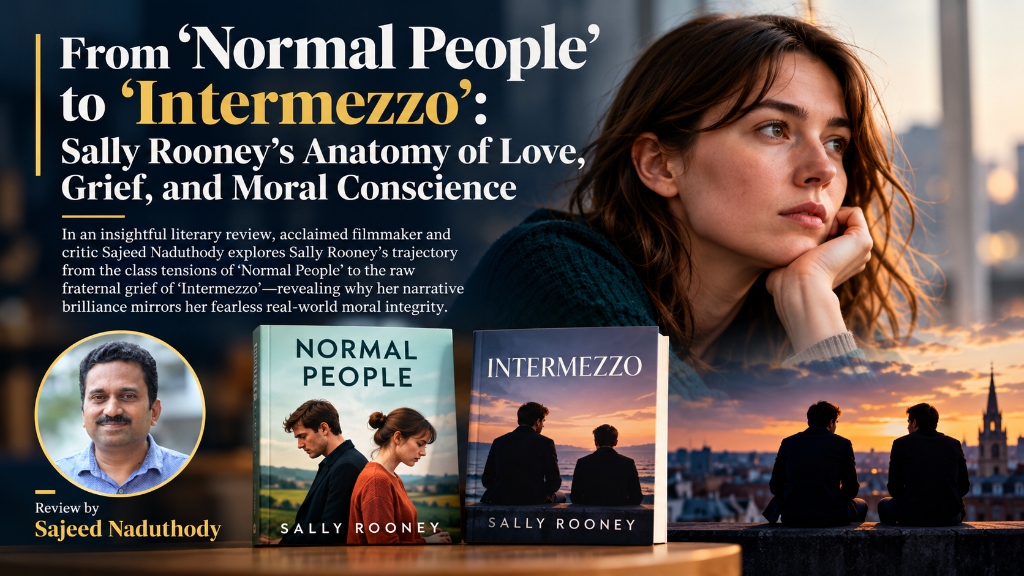
To read Sally Rooney is to submit to an intense, quiet scrutiny of what it actually feels like to be alive in an era of fractured intimacy, class precarity, and relentless moral compromise. With Normal People (2018), the Irish novelist captured a generational ache so precisely that she was almost immediately burdened with the suffocating mantle of “the first great millennial novelist.” Six years later, with Intermezzo (2024), Rooney has not merely outgrown that label—she has shattered it, producing a mature, deeply philosophical triumph about fraternal grief, chess, and the bewildering difficulty of human goodness.
As her literary work becomes embroiled in global headlines—following her principled refusal to retract support for Palestine Action despite her novels being withdrawn from UK distribution—it becomes impossible to separate Sally Rooney the stylist from Sally Rooney the moral thinker. Her prose has never been an escapist exercise. It has always been a rigorous, unflinching examination of human responsibility. Here, we delve into the emotional and thematic bridge connecting Normal People to Intermezzo, examining how Rooney has deepened her craft to produce the most resonant literature of the decade.
At a Glance: The Rooney Evolution
- Normal People (2018): A bittersweet, microscopic portrait of class divide, social anxiety, and unspoken devotion between Marianne Sheridan and Connell Waldron in Sligo and Trinity College Dublin.
- Intermezzo (2024): A profound, polyphonic inquiry into sibling grief, chess psychology, and radical romantic vulnerability through the lives of brothers Peter and Ivan Koubek.
- The Unifying Thread: How social systems (class, bereavement, legalism, and capitalism) constrain our capacity to touch each other’s souls—and how radical honesty offers our only salvation.
1. ‘Normal People’: The Geometry of Class and Unspoken Longing
When Normal People arrived in 2018, its brilliance was often mistakenly reduced to a conventional "will-they-won't-they" teen romance. Yet underneath the tender surface lay an astonishingly sharp class dissection. Set against the economic wreckage of post-Celtic Tiger Ireland, the novel maps the secret intimacy between Connell Waldron, a quiet, athletic working-class boy, and Marianne Sheridan, an eccentric, wealthy, but emotionally abused outcast whose mansion Connell's mother cleans.
What made Normal People so devastating was Rooney’s understanding of social velocity. In high school in Carricklea, Connell holds the social capital while Marianne is ostracized; at Trinity College Dublin, the hierarchy violently flips. Marianne flourishes effortlessly within the bourgeois literary circles, while Connell is hollowed out by economic alienation, struggling to afford rent and food while watching peers coast on generational wealth.
“Marianne had the sense that her real life was happening somewhere else, far away, and was going on without her, and she didn’t know if she would ever find out where it was and be part of it.”
— Sally Rooney, Normal People
Rooney’s signature stylistic restraint—her radical refusal to use quotation marks—dissolved the boundary between external speech and internal cognition. Characters in Normal People do not merely converse; their consciousness bleeds directly into one another. Love is portrayed not as a spectacle of grand romantic gestures, but as an awkward, terrifying vulnerability: the power to fundamentally alter another human being for good or ill.
2. ‘Intermezzo’: The Grief-Struck Chessboard of Adulthood
If Normal People was an etude on the anxieties of youth, Intermezzo is a full symphonic exploration of adult bereavement. The novel follows two estranged brothers in contemporary Dublin—Peter, thirty-two, a successful, polished human-rights barrister, and Ivan, twenty-two, an introverted, socially clumsy competitive chess prodigy—in the months immediately following the agonizing death of their father from cancer.
In chess, an intermezzo (or zwischenzug) refers to an unexpected in-between move that interrupts a calculated tactical sequence, throwing all established plans into disarray. The title serves as Rooney’s organizing metaphor for grief: death is not a destination or a tidy stage to be survived, but an agonizing intermezzo that derails the comfortable scripts we tell ourselves about who we are.
“Life without their father feels like a game where the board has been violently shaken. Pieces are standing in wrong squares; the rules no longer dictate safety. Each brother is forced to invent a language to stay alive.”
Peter copes with loss by numbing himself with prescription pharmaceuticals, alcohol, and chaotic compartmentalization. He oscillates between two starkly different women: Sylvia, his former university sweetheart and an academic whose life has been upended by a debilitating chronic pain condition, and Naomi, a free-spirited, twenty-three-year-old bohemian student who accepts financial assistance from Peter while offering him raw, unpretentious warmth. Peter’s inner monologue is fragmented, staccato, almost Joycean in its breathless anxiety, mirroring a man whose professional veneer is crumbling under unbearable sadness.
Ivan, meanwhile, encounters thirty-six-year-old Margaret at an exhibition chess tournament in a provincial town. Margaret, recovering from the quiet humiliation of a dissolved marriage, recognizes in Ivan’s awkward directness a purity that her peers have long abandoned. Their burgeoning affair, complicated by a fourteen-year age gap and societal judgment, unfolds with breathtaking tenderness. Rooney treats their intimacy with extraordinary patience, showing how two deeply insecure souls can build a sanctuary of quiet dignity away from the world's transactional gaze.
3. Fraternal Friction and the Polyphony of Style
What elevates Intermezzo beyond Rooney’s earlier works is its startling stylistic ambition. Rather than employing a uniform minimalist register, Rooney crafts distinct linguistic landscapes for each brother:
- Peter’s Stream of Consciousness: Elliptical, fragmented, telegraphic sentences that evoke the speed and panic of modern professional life. His thoughts mimic Beckettian monologues—erratic, self-lacerating, and haunted by fear of moral failure.
- Ivan’s Spatial Logic: Precise, analytical, and geometrically grounded. Ivan experiences social interaction through the lens of pawn structures, tempi, and tactical balances, yet beneath his tactical detachment lies a tender capacity for uncalculated love.
When the two brothers finally collide in explosive confrontation—exchanging years of accumulated resentment, unspoken jealousies, and mutual feelings of inadequacy—the emotional payoff is monumental. Rooney does not offer trite familial reconciliations; instead, she offers something far more honest: the mutual recognition that both brothers are clumsy, broken men struggling to honor the ghost of a father they loved.
4. The Politics of Tenderness: Art, Capitalism, and Moral Integrity
It is impossible to appreciate Sally Rooney without recognizing her Marxist worldview. In both Normal People and Intermezzo, romance is never decoupled from the material conditions of capitalism. Characters worry about rent; they confront the stark reality of healthcare costs, precarity, and student debt. Relationships are tested not by abstract fate, but by economic realities.
Yet Rooney’s genius lies in demonstrating that intimacy itself is the ultimate counter-cultural act. In a world that commodifies attention and treats human beings as disposable utility functions, loving someone with genuine patience is a radical rebellion.
This moral consistency explains the author's real-world fearlessness. When UK distributors announced the withdrawal of her novels over her refusal to stop supporting Palestine Action, Rooney’s public response was characteristically calm and uncompromising. Just as her protagonists refuse to compromise their dignity to fit polite social expectations, Rooney herself refuses to trade moral conviction for commercial marketability. In an era when public figures frequently dilute their ethics for corporate convenience, Rooney’s steadfastness lends an unassailable authenticity to the moral struggles depicted on her pages.
5. Comparative Critical Analysis: ‘Normal People’ vs. ‘Intermezzo’
6. Verdict: A Masterpiece That Outlives the Noise
Intermezzo proves unequivocally that Sally Rooney was never an ephemeral literary trend. She is a consummate craftsman of the highest order. By turning her gaze from the romantic agonies of youth toward the devastating architecture of fraternal grief and unconventional love, she has created her most humane, emotionally generous, and artistically daring novel to date.
For readers who cherished Normal People for its unflinching emotional precision, Intermezzo offers a deeper, richer revelation. It reminds us that while death and societal judgment may violently disrupt the chessboard of our lives, the in-between moves—the quiet acts of listening, forgiving, and daring to love across impossible divides—are the only things that truly make us human.



Comments (0)
No comments yet. Be the first to share your thoughts!
Leave a Comment