Australia Puts AI Safety at Heart of Foreign Policy
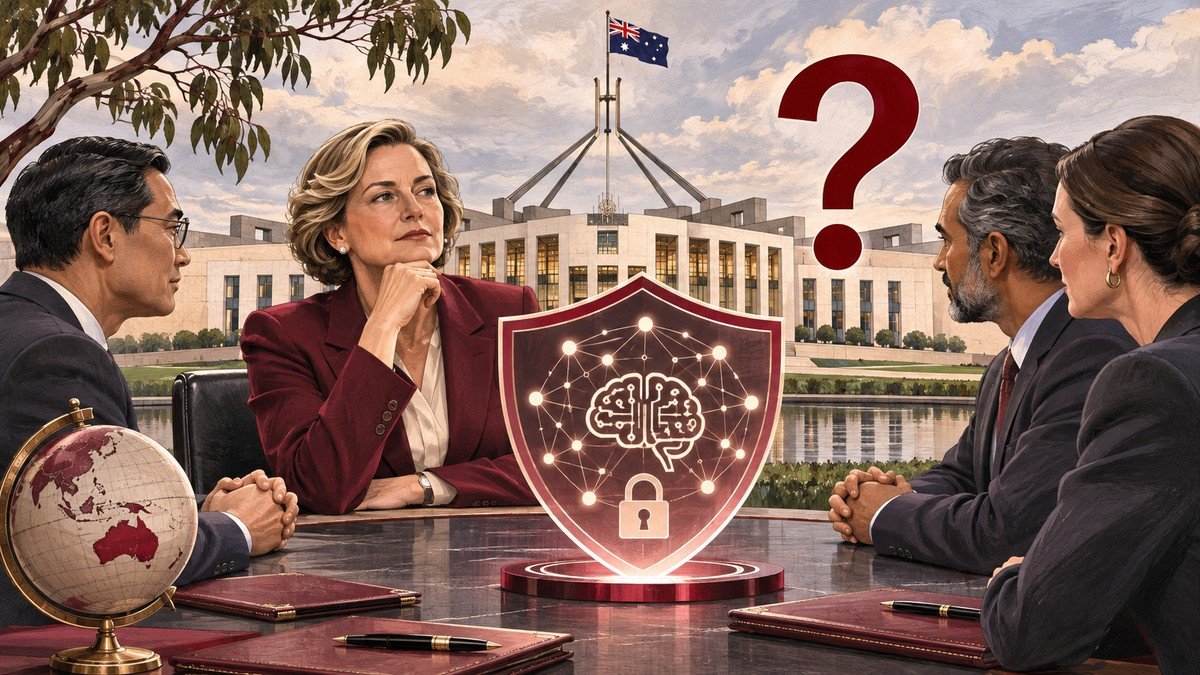
Australia's Foreign Minister Penny Wong declares AI a force reshaping global power, warning it complicates foreign interference detection. The move signals a strategic shift, but questions remain about practical implementation.
Executive Takeaways
- Australia is elevating artificial intelligence as a central element of its foreign policy, with Foreign Minister Penny Wong set to declare AI a force reshaping economic and strategic power.
- Wong warns that AI could make foreign interference harder to detect, signaling a shift toward integrating AI safety into national security strategy.
- The move positions Australia as a potential leader in global AI governance, but practical implementation remains uncertain.
- Experts question whether Australia can translate rhetoric into action, given the borderless nature of AI and competing national interests.
- Markets and tech firms are watching for concrete policy measures, including potential regulations and international partnerships.
The Core Event & Breaking Timeline
On November 23, Reuters reported that Australia's Foreign Minister Penny Wong planned to use a parliamentary statement to describe artificial intelligence as one of the forces reshaping economic and strategic power. According to the report, Wong intended to warn that AI could make foreign interference harder to recognise, underscoring the technology's growing significance in national security and diplomacy. The statement, delivered in the Australian Parliament, marks a formal elevation of AI in the country's foreign policy framework, signaling a strategic shift toward treating AI safety as a core component of international engagement.
The timing of Wong's statement is notable, coming amid heightened global scrutiny of AI's impact on geopolitics. In recent months, the United States, the European Union, and China have all accelerated their AI governance efforts, with the U.S. issuing an executive order on AI safety in October and the EU advancing its AI Act. Australia's move can be seen as part of a broader trend among middle powers to carve out a role in shaping global AI norms. Wong's remarks also follow a series of high-profile incidents involving AI-driven disinformation and cyberattacks, which have raised alarms about the technology's potential to destabilize democracies.
Initial market reaction was muted, as the announcement lacked specific policy details. However, analysts noted that the statement could have long-term implications for Australia's tech sector, particularly for companies involved in AI development and cybersecurity. The Australian dollar showed little movement against major currencies, and the ASX 200 Information Technology index remained flat on the day. Investors are likely awaiting concrete measures, such as new regulations or funding initiatives, before adjusting their positions. The lack of immediate market volatility suggests that stakeholders view the announcement as a strategic signal rather than an imminent regulatory shake-up.
The parliamentary statement also comes as Australia prepares to host a series of international dialogues on AI governance in 2024, including a planned summit with Pacific Island nations focused on AI and regional security. Wong's emphasis on foreign interference aligns with Australia's broader national security strategy, which has increasingly focused on countering influence operations from state actors. By framing AI as a foreign policy issue, the government aims to build coalitions and set norms that protect democratic processes while fostering innovation. The move is expected to be followed by a detailed policy paper in early 2024, outlining specific actions and partnerships.
Deep Technical & Financial Architecture
At the heart of Australia's AI foreign policy push is the recognition that AI technologies are dual-use, capable of both driving economic growth and enabling malicious activities. The technical architecture of AI systems—ranging from large language models to autonomous systems—relies on vast data sets, computing power, and algorithms that often transcend national borders. This borderless nature makes regulation challenging, as AI models can be trained in one country, deployed in another, and affect a third. Australia's approach appears to focus on building international norms and standards, rather than unilateral bans, to address these complexities.
From a financial perspective, the global AI market is projected to reach $1.8 trillion by 2030, according to Grand View Research, with significant investments flowing into AI safety and security. Australia's AI sector, while smaller than those of the U.S. and China, has been growing rapidly, with AI-related startups attracting over AUD 1 billion in venture capital in 2022. The government's emphasis on AI safety could catalyze further investment in Australian firms specializing in AI auditing, risk management, and secure AI deployment. However, without concrete funding commitments, the impact on the local tech ecosystem may be limited in the near term.
The unit economics of AI safety are complex. Developing robust AI safety measures—such as bias detection, adversarial testing, and explainability tools—requires significant R&D investment, often beyond the reach of smaller enterprises. Governments can play a role by funding research and creating incentives for adoption. Australia's Commonwealth Scientific and Industrial Research Organisation (CSIRO) has been active in AI safety research, but its budget is modest compared to similar institutions in the U.S. and EU. The government's new focus may lead to increased funding for CSIRO's Data61 and other research bodies, but details remain scarce.
On the balance sheet, the Australian government's fiscal position allows for targeted investments in AI safety, but competing priorities such as healthcare and defense may limit available funds. The 2023-24 federal budget allocated AUD 101.2 million for AI initiatives, including a new AI Centre and grants for businesses. Whether additional funds will be directed toward foreign policy-related AI safety measures is unclear. Analysts suggest that Australia could leverage public-private partnerships to share the costs and risks of AI safety research, similar to models used in the U.S. and UK.
The technology stack for AI safety encompasses a range of tools and frameworks, from secure hardware to privacy-preserving machine learning. Australia's strengths lie in areas such as cybersecurity and data privacy, with firms like Kasada and Airwallex gaining global traction. By integrating AI safety into foreign policy, Australia could promote its tech solutions internationally, potentially boosting exports. However, the country faces fierce competition from larger players, and without a coordinated national strategy, its influence may be diluted.
Industry & Global Market Ripple Effects
Australia's announcement is likely to reverberate across the global AI landscape, particularly among like-minded democracies seeking to counter authoritarian AI models. The U.S. has welcomed Australia's stance, with a State Department spokesperson noting that "Australia's leadership on AI safety is crucial for maintaining a free and open Indo-Pacific." The EU, which has taken a more regulatory approach, may see Australia as a potential ally in promoting global AI standards. Conversely, China has criticized what it perceives as a Western attempt to impose AI norms, accusing Australia of aligning too closely with U.S. interests.
For Australian tech companies, the move could open doors to new markets and partnerships, especially in the Indo-Pacific region. Countries such as Japan, South Korea, and Singapore are investing heavily in AI and may seek collaboration on safety frameworks. Australian firms specializing in AI ethics and governance, such as Gradient Institute and the Human Technology Institute, could benefit from increased demand for their expertise. However, they also face competition from established players in the U.S. and Europe, which have deeper pockets and more experience in international standard-setting.
Supply chains for AI hardware, particularly semiconductors, are another area of impact. Australia does not have a significant semiconductor manufacturing base, but it is rich in critical minerals like lithium and rare earths essential for AI chips. By emphasizing AI safety, Australia could leverage its resource advantage to attract investment in downstream processing and manufacturing, though this would require substantial infrastructure development. The government's Critical Minerals Strategy, announced in 2023, aims to boost processing capabilities, but progress has been slow.
Investors are closely watching for signals of increased government spending on AI safety and security. Venture capital firms with a focus on deep tech, such as Main Sequence Ventures and Blackbird, have already been active in the Australian AI space. A clear policy framework could de-risk investments and attract more global capital. However, some investors worry that overly stringent regulations could stifle innovation, particularly for startups that lack the resources to comply with complex rules. The government will need to strike a balance between safety and fostering a vibrant AI ecosystem.
Critical Perspectives, Analyst Debates & Risk Factors
While the government's emphasis on AI safety is broadly welcomed, critics question whether Australia has the capacity to translate rhetoric into meaningful action. "Australia is a middle power with limited leverage in global AI governance," said Dr. Zoe Hawkins, a senior fellow at the Australian Strategic Policy Institute. "Without significant investment in AI capabilities and diplomacy, the risk is that this announcement becomes just another statement of intent." Others point out that Australia's own record on AI regulation is patchy, with no dedicated AI act and reliance on existing privacy and anti-discrimination laws.
There is also debate over the focus on foreign interference. Some experts argue that while AI can indeed be used to spread disinformation, the bigger threat is the use of AI for cyberattacks and autonomous weapons. "Foreign interference is a symptom, not the disease," said Professor Toby Walsh, a leading AI researcher at UNSW Sydney. "We need to address the root causes, including the lack of international norms on AI in warfare." The government's framing may therefore be too narrow, potentially missing other critical AI risks.
Regulatory friction is another concern. Australia's approach to AI safety will need to align with existing international frameworks, such as the OECD AI Principles and the Global Partnership on AI (GPAI). As a member of GPAI, Australia has committed to responsible AI development, but its foreign policy push may create tensions with trading partners who have different regulatory philosophies. For instance, the U.S. has taken a more light-touch approach to AI regulation, while the EU is moving toward strict rules. Australia will need to navigate these differences carefully to avoid isolating itself.
Vulnerabilities in the AI supply chain also pose risks. Australia's reliance on foreign AI technologies, particularly from the U.S. and China, makes it susceptible to supply chain disruptions and geopolitical pressures. The government's push for AI safety may accelerate efforts to develop sovereign AI capabilities, but this will require significant investment and time. In the meantime, Australia remains exposed to the same AI risks as other nations, including data breaches, algorithmic bias, and autonomous systems failures.
Strategic Forecast & Road Ahead
In the next 12 to 24 months, Australia is expected to release a detailed AI foreign policy strategy, likely in the first half of 2024. This document will outline specific initiatives, such as the establishment of an international AI safety institute, funding for AI safety research, and partnerships with regional allies. The government may also appoint a dedicated AI ambassador or envoy to lead diplomatic efforts. These steps will be closely watched by industry and international partners for signs of Australia's commitment.
Key milestones to watch include the 2024 Pacific Islands Forum, where AI is expected to be a major topic, and the G20 summit in Brazil, where Australia may push for AI safety to be included in the communique. Additionally, Australia's participation in the U.S.-led AI Safety Institute network, announced in November 2023, will be a test of its ability to contribute meaningfully to global AI governance. The government has also signaled that it will review its export controls on AI technologies, which could impact Australian companies selling AI products abroad.
On the domestic front, the government is expected to introduce legislation to regulate high-risk AI applications, following recommendations from the Department of Industry, Science and Resources. This could include mandatory risk assessments for AI systems used in critical infrastructure, healthcare, and law enforcement. The legislation will need to balance safety with innovation, and its passage through parliament may face hurdles, given competing priorities and potential opposition from industry groups.
Ultimately, Australia's ability to make AI safety a practical part of foreign policy will depend on sustained investment, political will, and international cooperation. The announcement by Foreign Minister Wong is a promising first step, but the hard work lies ahead. As AI continues to evolve at a rapid pace, Australia must remain agile and proactive to protect its interests and contribute to a safe and secure global AI ecosystem.


Comments (0)
No comments yet. Be the first to share your thoughts!
Leave a Comment